Here is the question: the Earth is about 24,900 miles around. A runner can cover that distance much faster than a walker. How long does it actually take?
The honest answer is: longer than it looks, but shorter than you might expect, and three real humans have actually done versions of it.
The quick math
| How you run | Daily distance | Time to cover 24,901 miles |
|---|---|---|
| Weekend jogger | 3 miles/day | about 22.7 years |
| Regular runner | 10 miles/day | about 6.8 years |
| Dedicated distance runner | 20 miles/day | about 3.4 years |
| Serious ultra-runner | 40 miles/day | about 1.7 years |
| Tom Denniss’s certified pace | ~26 miles/day | about 2.6 years at that rate |
| Brisk walker for comparison | 15 miles/day | about 4.6 years |
One important caveat: about three-quarters of the equator is ocean. You cannot run on water. Real circumnavigation runners chain together continental crossings by foot and bridge the ocean gaps by plane or boat. That means the certified distance for a running circumnavigation (about 16,300 miles) is shorter than the full 24,901-mile equatorial circumference, but the time per land mile is exactly the same.
For how the same distance plays out at walking speed, see how long it would take to walk around the world.
The people who actually did it
Tom Denniss, an Australian scientist and endurance athlete, completed a Guinness World Records-verified running circumnavigation, covering roughly 26,232 km (about 16,300 miles) in approximately 622 days. He ran across Europe, the United States, Australia, and other continental segments, flying over the ocean gaps. His daily average worked out to about 26 miles, which is nearly a marathon every single day, sustained for well over a year. He later wrote a book about the experience.
Jesper Olsen, a Danish ultra-runner, completed his own certified circumnavigation, running eastward from Greenwich through Europe, Russia, Canada, and the United States, before returning to London. His route covered approximately 26,900 km. Olsen has spoken about the mental endurance required being at least as demanding as the physical, particularly on the long Russian and Canadian stretches where the terrain was monotonous and the population sparse.
Robert Garside, a British-born endurance runner who went by “The Runningman,” spent years crossing multiple continents by foot in an attempt to run the globe. His record attracted skepticism and controversy, but Guinness eventually certified his circumnavigation. He crossed dozens of countries and said afterward that the most memorable parts were not the distances or the records, but specific acts of generosity from strangers in places he never would have visited otherwise.
Three different people, three different routes, three different experiences. The number that connects all of them: roughly 16,000 to 17,000 land miles covered on foot.
Why it takes so much longer than a sprint
The challenge of running around the world is not a single day’s effort. It is what happens on day 400.
A well-trained runner can sustain 20 to 30 miles a day for weeks. What breaks most attempts is the cumulative load. Shin splints, stress fractures, tendon damage, and fatigue from inadequate sleep add up over months. Tom Denniss and Jesper Olsen both dealt with serious injuries along the way and had to adjust their daily mileage accordingly.
Most people who have attempted long-distance running challenges that go on for months find that their average on running days ends up lower than their goal, and rest days are not optional, they are mandatory. A conservative planning assumption is 20 to 25 miles per running day with one or two rest days per week, which puts the weekly total around 100 to 150 miles and the full 24,901-mile circumference at three to four years at the full equatorial distance.
That is a long time. It is also, as multiple finishers have noted, a different kind of time.
The continental legs
One reason a running circumnavigation is conceivable when it sounds impossible is that it breaks into named legs anyone could point to on a map:
| Leg | Approximate land miles |
|---|---|
| Lisbon to Istanbul (Europe) | about 2,800 miles |
| Istanbul to Vladivostok (Central Asia to Russian Far East) | about 5,500 miles |
| Anchorage to Mexico City (North America, southbound) | about 4,500 miles |
| Mexico City to Buenos Aires (South America) | about 7,500 miles |
Each of those is a journey. Some of them have been run as standalone challenges. The Trans-America Run from Los Angeles to New York is roughly 2,900 miles and has its own community of people who have finished it. The Pan-American Route from Alaska to the tip of South America is one of the classic long-distance goals for cyclists and runners alike.
For the North American stretch by bike, see how long it would take to bike around the world.
What it takes in time, year by year
If your goal is not a world record but simply to cover the equivalent of a running circumnavigation in your lifetime, here is how the math works at different steady paces:
| Annual running mileage | Years to reach 16,300 miles | Years to reach 24,901 miles |
|---|---|---|
| 500 miles/year (about 10 mi/week) | about 32 years | about 50 years |
| 1,000 miles/year (about 20 mi/week) | about 16 years | about 25 years |
| 1,500 miles/year (about 30 mi/week) | about 11 years | about 17 years |
| 2,000 miles/year (about 38 mi/week) | about 8 years | about 12 years |
A runner covering 30 miles a week is not an elite athlete. That is someone who goes out four or five days a week for a moderate run. At that pace, they cross the equivalent of a Guinness-certified running circumnavigation in about 11 years, and the full equatorial distance in about 17.
Most people who have been running that steadily for 10 years have no idea how far they have gone. The cumulative number, once you see it, tends to be surprising.
The group version: cover the distance without leaving home
Running around the world is a solo endeavor when one person attempts it. When a family or group attempts it as a shared distance goal, it becomes something else.
Consider: 24,901 miles sounds impossible for one person in a reasonable time. But if five family members each contribute 5 miles a day through running, walking, hiking, or cycling, the group covers 25 miles a day and reaches 24,901 miles in about 2.7 years.
| Group size | Average per person per day | Group miles/day | Time to 24,901 miles |
|---|---|---|---|
| A couple | 5 miles each | 10 | about 6.8 years |
| A family of 5 | 5 miles each | 25 | about 2.7 years |
| A family of 10 | 5 miles each | 50 | about 1.4 years |
| A group of 20 | 5 miles each | 100 | about 8 months |
The mix matters too. A grandparent’s morning walk, a college student’s training runs, and a parent’s weekend hike all count. Nobody has to be a runner. The goal is the shared distance, and every kind of movement adds to it.
Why this goal is worth having
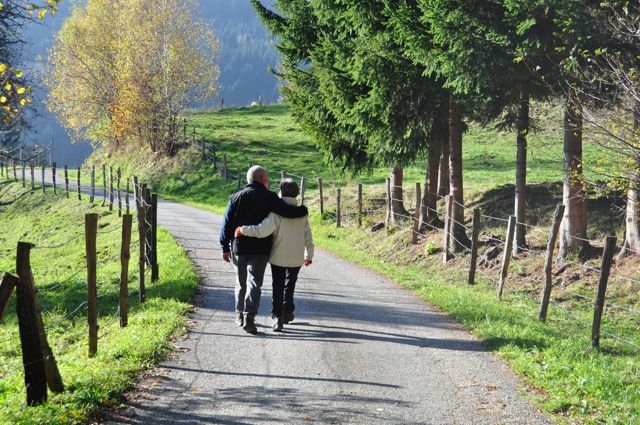
We live on a small rock. The circumference of that rock, measured at the equator, is 24,901 miles. A healthy human body, moving consistently across a lifetime, covers something in that range through walking, running, hiking, and cycling. Usually much more.
Dave, who built Trek Together and is in his 70s, keeps coming back to a simple version of this: you have roughly a hundred years here, and your body will carry you a long way if you keep using it. The distance does not lie. Life is short, run as far as you can.
A world-circumference goal gives that a shape. You do not have to book a flight to Lisbon. You do not have to run through Kazakhstan. You just have to keep moving, and let the miles add up.
Tracking the journey together
You can track a round-the-world challenge with a shared spreadsheet. If your group spans several cities or time zones, an app that handles the math and keeps everyone on one map tends to work better.
Trek Together lets a family or group pick a real route between real places, invite everyone with a link, and watch one shared marker move as each person’s daily miles sync automatically from Apple Health. The app routes inside continents; for the ocean crossings, you pick the next starting point and keep going, the same way every real circumnavigation runner has handled the Pacific.
Pick a starting city. When the group reaches the destination, celebrate, pick the next leg, and go.
Trek Together is an iPhone app for shared journeys on real maps. Pick a route, invite the people you love, and every mile you each cover moves you forward together. Free 7-day trial, then $4.99/month.